
Thousand Oaks Directory Holdings by Era
A Thousand Oaks city directory search starts by naming the keeper, the years, and the kind of entry. The verified reverse run is held by the Library of Congress, while the Thousand Oaks Library supplies local newspaper indexes, digital images, and catalog help. Those are different collections. The library’s online holdings page does not enumerate a complete run of printed directory volumes or a confirmed publisher list, so the table keeps the evidence lines separate.
| Collection | Years | Where Held | Access |
|---|---|---|---|
| Oxnard-Camarillo-Thousand Oaks street-address directories | 1962 to 1985 | Library of Congress | Digital address-order images |
| Santa Paula regional telephone book, Thousand Oaks pages | 1958 | Library of Congress | Digital pages 97 to 100 |
| Thousand Oaks Local History Collection | 1890s onward images | Thousand Oaks Library CONTENTdm | Free browse and search |
| News Chronicle image collection | Twentieth-century local images | Thousand Oaks Library CONTENTdm | Free digital image records |
| Local News Index | 1985 to April 20, 2016 | Thousand Oaks Library | Free index; microfilm for articles |
| U.S. census schedules | 1790 to 1950 | NARA and partners | Released schedules; local use after settlement |
| Gallegly Archive | 1987 to 2013 service records | Cal Lutheran Pearson Library | Special-collections access; confirm restrictions |
The table separates Library of Congress ownership from local holdings and shows where each lead can be checked.
Note: No verified local Polk, Sanborn, or first-and-last printed directory run was found, so those gaps remain open rather than guessed.
Thousand Oaks Criss-Cross Directories, 1962 to 1985
The Library of Congress run titled Oxnard, Camarillo, Thousand Oaks, California, 1962 to 1985 is the strongest address-based city directory source located for the area. A criss-cross directory reverses the usual name order. Street and house number come first, followed by the listed occupant or telephone subscriber. Consecutive editions can show an arrival, departure, or change in a listing without claiming that the entry is a deed.
Use one volume at a time. Record the street spelling, number, locality, name, and any nearby listing before comparing the next edition. Adjacent entries can sketch a historical block, while a name search can show when a household appears or vanishes. The run belongs to the Library of Congress collection, not a verified Thousand Oaks Library ownership list.
- Choose the year closest to the event or address clue.
- Read the street-order pages and copy the exact entry and page image.
- Compare the same address in the next available edition.
- Check a deed, census schedule, or newspaper citation before treating the listing as identity evidence.
For a current address-keyed trail, continue with the Thousand Oaks street records page; the historical directory is best used as one dated layer.
Thousand Oaks 1958 Telephone Directory
The Library of Congress digitized a Santa Paula regional telephone directory with Thousand Oaks material on images 97 through 100. Image 100 announces that Thousand Oaks-area numbers in the special section became effective June 29, 1958 and names the HUdson exchange. That cutover gives a searcher a precise point at which a phone listing may change, but it does not establish a local publisher or a complete household roll.
Rural entries may use a locality or property description instead of a numbered street. Lake Sherwood is one reason a literal street search can miss a useful record. The page image, not OCR alone, should control transcription because the research inspection found imperfect OCR.
| Name | Personal or business name in alphabetical order |
|---|---|
| Location | Street number and street or a rural locality when supplied |
| Exchange | HUdson telephone number |
| Business entry | Some business and water-company names |
| Not observed | No spouse or occupation field in this telephone sample |
Visible examples include Roberts Donald M at 3185 Ventura Blvd, Rockhold Jos S at 2727 Hillcrest Dr, and Rockwood Mutual Water Co. at 100 Ventura Blvd. They show the shape of a record, not title, occupancy, or every person in a home.
Reading a Thousand Oaks Directory
A city directory entry is an index clue. Read the name, address, locality, and any exchange or note as separate pieces. Do not fill in missing facts from a modern assumption. A listed phone subscriber may be a relative, a business, or the person who paid for the line. A street address may also sit in a postal community that differs from the legal city.
- Criss-cross directory
- An address-order directory that lets a researcher start with a street and see listed names.
- Householder index
- An alphabetic name section that points to a household entry when a volume includes one; confirm its presence in the volume.
- Abbreviation key
- The volume's explanation of short forms and marks; read it before interpreting an entry.
- Index versus image
- An index points to a record, while the scanned page preserves the printed context and spelling.
For the 1958 sample, the safest transcription is the name, street or locality, and HUdson number shown on the page. The reverse volumes from 1962 to 1985 add the address-order perspective. Neither source replaces a recorded deed, a census schedule, or a custodian-held vital record.
Thousand Oaks Directory Name Index Search
The Thousand Oaks Library Local News Index adds a people-and-events layer to a name search. It covers 1985 through April 20, 2016 and indexes the News Chronicle, Thousand Oaks Star, Los Angeles Times Ventura County edition, Daily News Conejo Valley section, and Our Times. Article types include obituaries, birth announcements, marriage announcements, photographs, maps, letters, editorials, and statistics.
Use personal names as subjects in last-name-first form, then add a date or newspaper limit when the result set is broad. The index accepts a date in year-month-day order, with month and day optional. Case and punctuation are ignored, and an asterisk wildcard can bridge spelling variants. A result citation can show the byline, headline, paper, complete date, section, page, column, subjects, article type, birth or death dates, and notes.
Full News Chronicle articles are available on library microfilm or databases rather than assumed from the citation. Request a reel at the reference desk and print a needed page for $0.15. A name-only hit should be paired with a second fact such as an address, relative, organization, or date.
Open the Local News Index before relying on a copied snippet:
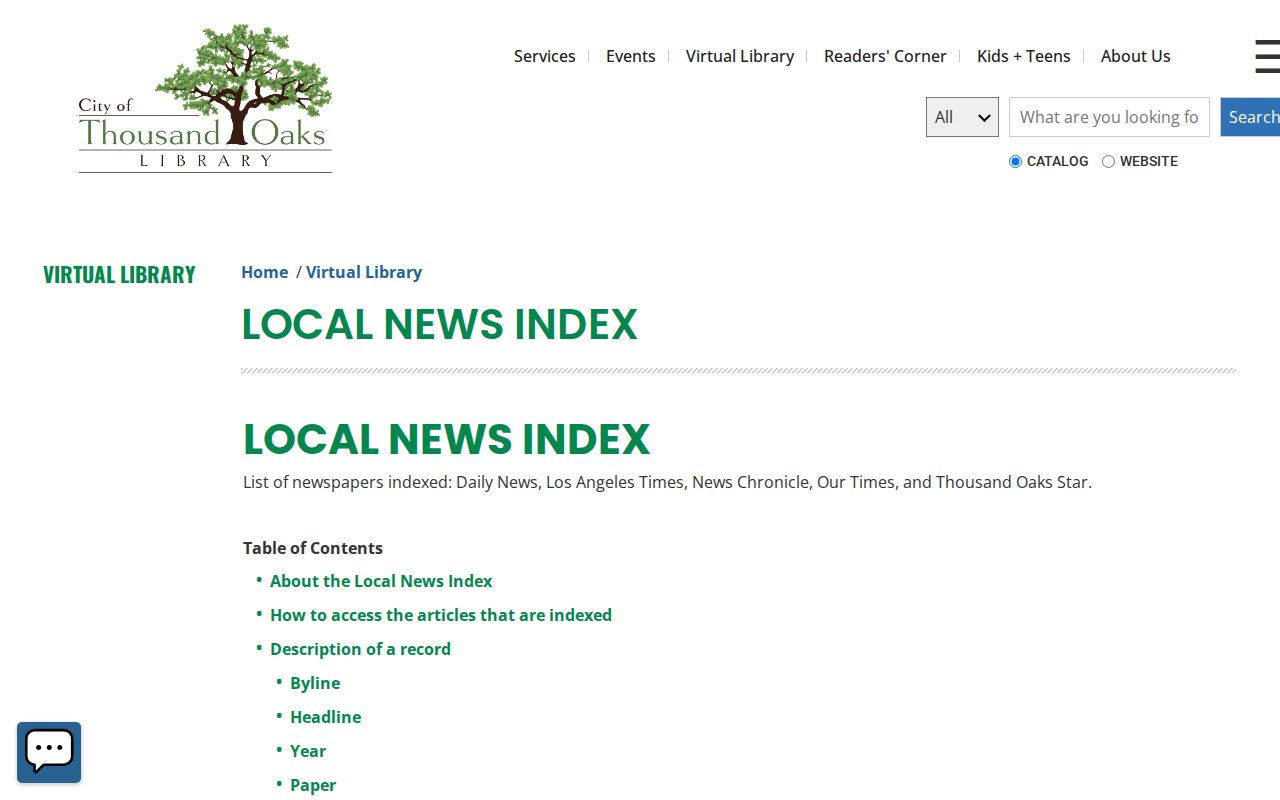
The library index is useful for locating an obituary or announcement, while the underlying newspaper supplies the context that a short citation cannot show.
Thousand Oaks CONTENTdm Directory Clues
The Thousand Oaks Library CONTENTdm collection reaches back to images from the 1890s onward. It includes buildings, ranches, commercial operations, land use, civic events, and pioneer families. The News Chronicle file exceeds 100,000 local images donated by the Ventura County Star in 2001, while the broader local-history collection exceeds 1,800 books, photographs, and pamphlets.
These images do not replace a printed volume, but a street name, business sign, family connection, or civic event can distinguish two people with the same name. Preserve the metadata and confirm the date or place elsewhere.
Open the CONTENTdm image collection to see why local visual records belong beside a directory rather than behind it:
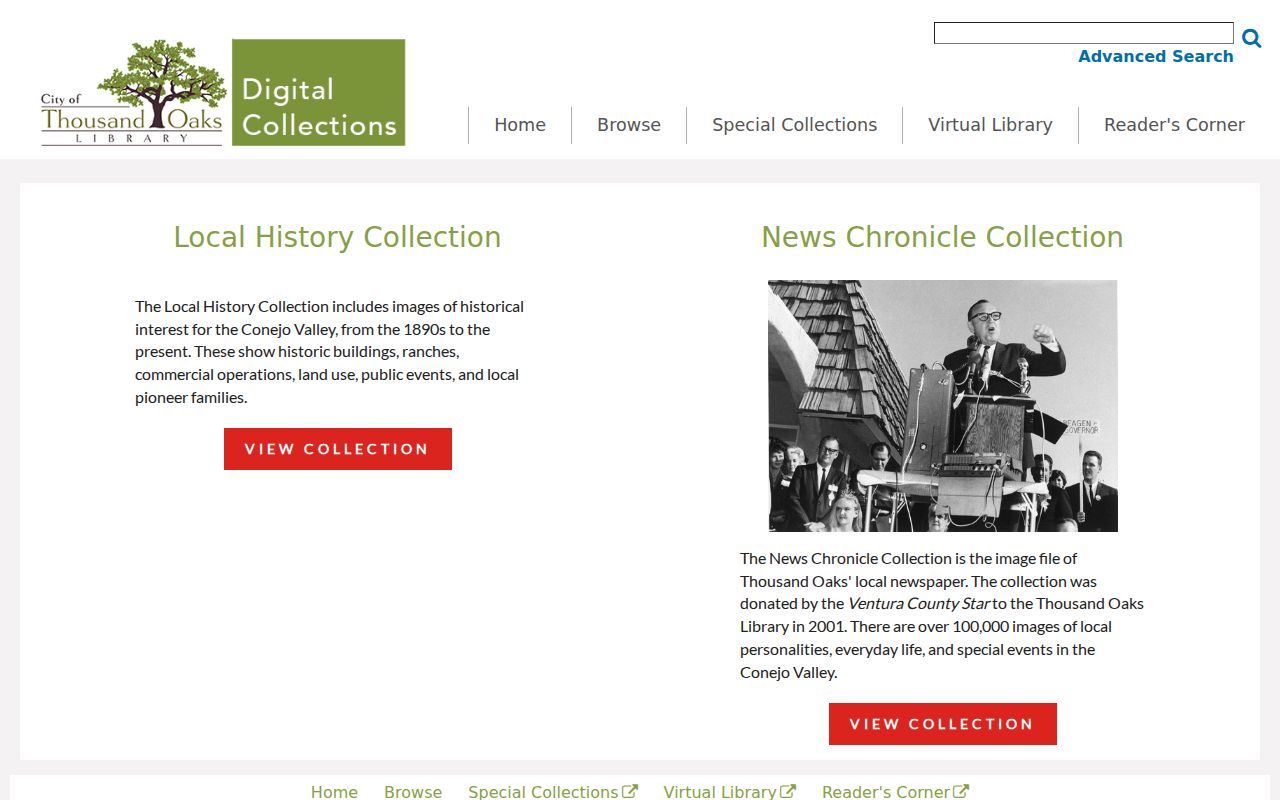
The image collection adds place and community context, but a photograph still needs its caption, date, and related records before it can identify a resident.
Thousand Oaks Holdings Catalog Trail
The Thousand Oaks Library catalog is the practical starting point for checking whether a book, microfilm title, local-history pamphlet, or newspaper resource is held at Grant R. Brimhall Library or Newbury Park Branch. Grant R. Brimhall Library is at 1401 E. Janss Road and can be reached at (805) 449-2660. The Newbury Park Branch is at 2331 Borchard Road, with (805) 498-2139.
Search the catalog by place, surname, newspaper, or subject rather than assuming a directory label is complete. Special Collections gathers Conejo Valley newspapers, local-history photographs, pamphlets, and printed local history. Staff can point to local material, but the verified years remain the named collections above.
California Lutheran University Pearson Library Special Collections, at 60 W. Olsen Road #5100, holds the Gallegly Archive of 356 boxes from Representative Elton Gallegly’s 1987 to 2013 congressional service. It includes correspondence, reports, photographs, clippings, and constituent requests; confirm privacy restrictions before requesting person-linked material. The library collections page and Gallegly Archive announcement are the verified starting points.
A catalog record is a finding aid, not proof that a particular page contains a name. Check the holding, format, and access note before making a trip or asking for microfilm.
Check the library catalog before treating a holding as confirmed:
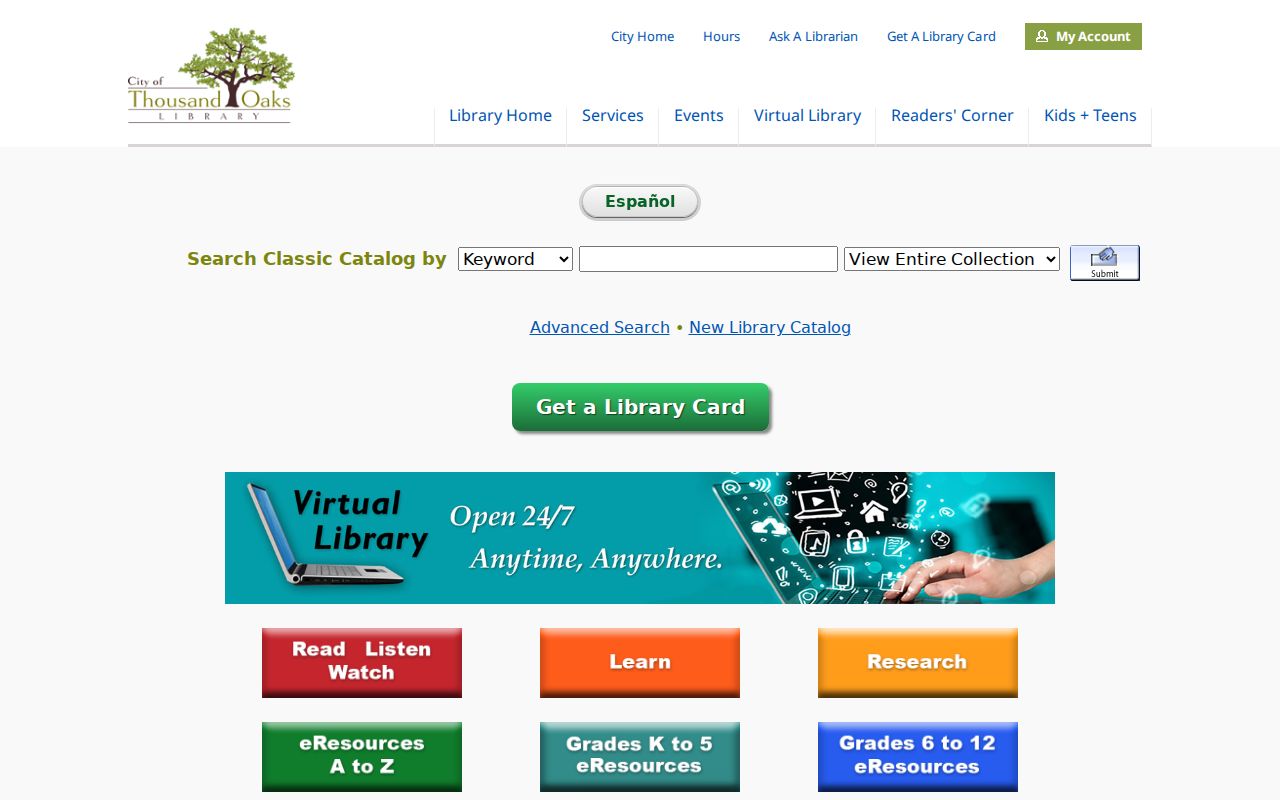
Catalog evidence helps locate the next source; the dated volume or image remains the record to read.
Trace Thousand Oaks Directory Families
Family history works best when a city directory year is treated as a fixed point, not a complete life story. Thousand Oaks incorporated on September 29, 1964, so an earlier resident may be indexed under Ventura County, Conejo Valley, Newbury Park, or a ranch and locality name. The 1950 census can anchor a household before the city had its current municipal record identity.
- Start with the name and a likely year in the 1962 to 1985 address run or the 1958 telephone pages.
- Copy each address, exchange, locality, and nearby listing, then compare the next available edition.
- Search the Local News Index for an obituary, birth notice, marriage announcement, or civic mention using name variants.
- Pair the directory clue with the 1950 Ventura County census search and an official record when the relationship matters.
- Close the trail with the underlying newspaper, a deed, probate record, or vital copy that fits the same dates and people.
A person can disappear from one city directory because of a move, death, an unlisted number, or a change in the source's coverage. Comparing editions and independent records is the way to separate those possibilities.
Thousand Oaks Records Before 1964
The September 29, 1964 incorporation date changes the custodian question. Earlier civic and resident trails generally sit in county, census, newspaper, library, or family sources rather than City of Thousand Oaks municipal files. The city’s local-history chronology records Chumash communities, Spanish land grants, a post office opened in 1875, and the Janss family’s early twentieth-century community planning, but those facts do not turn every older name into a city record.
- 1875: A post office opened in the settlement’s earlier record landscape.
- September 29, 1964: Residents incorporated the City of Thousand Oaks.
- 1985 to 2016: The library’s Local News Index bridges later newspaper citations.
Use the city local-history chronology to orient a search, then return to the dated directory, census schedule, newspaper image, or county record. The split between municipal and county custody is especially important for a name that appears before incorporation.
Thousand Oaks Directory Gaps and Honest Limits
No authoritative local source verified a first or last printed Thousand Oaks city directory year, a Polk publisher run, or a Thousand Oaks-specific Sanborn map. UCSB’s historic USGS quadrangle inventory offers map alternatives, including 1950, 1952, 1967, 1976, and 1981, but those are not city directory volumes. Naming the gap keeps a plausible lead from becoming a false fact.
A directory can place a name at a date, but cannot prove ownership, a full household, current residence, or kinship. Compare it with the custodian and preserve the page image for genealogy, reconnection, estate, or civic research.
Comparison: a reverse directory answers “who was listed at this address?” A deed answers “what transfer was recorded?” A newspaper citation answers “what event was reported?” Each source is stronger when its role stays clear.