
Trace a Thousand Oaks Street by Address
A Thousand Oaks street directory workflow begins with a physical address, not a guessed name. Resolve it to an APN and situs in County View, use the Assessor to separate owner from mailing address, then carry the owner into the Ventura Recorder's grantor and grantee index. A deed chain can link current records to earlier sellers. Voter records come later: the status tool checks the requesting voter, while broader files require an approved purpose. Criss-cross volumes can add a past listed subscriber, but not a complete household.
- Enter the address in County View through Assessor situs autocomplete. Save the APN, tract or map reference, and legal-description clues.
- Compare the parcel with the Ventura County Assessor property search. Note owner, situs, mailing address, values, and exemptions.
- Search the current owner as grantee in the Ventura County Recorder index. Record the acquisition instrument and seller.
- Treat voter information as a legal boundary. Use self-status only for the requesting voter or pursue an approved file request.
- For older evidence, open the Library of Congress run, compare 1962 to 1985 editions, and place each subscriber beside the deed trail.
Sources answer distinct questions and should not be interchanged.
Thousand Oaks Street Parcels from an Address
County View is the map bridge in the Thousand Oaks street directory. Its address lookup uses Assessor situs autocomplete. Select a candidate, let the map zoom and highlight the parcel, then open attributes or the Assessor map link. Situs means the physical location, not the mailing address used for assessment notices.
County View supports APN text search, map selection, and multipart graphics. Its public parcel fields do not expose owner names or mailing addresses, so those values belong in the Assessor roll or at the counter. Parcel inventory. An APN result becomes visible near 1:12,000 and can show status, situs number, direction, street and suffix, tract, map, zone, acreage, book, page, block, parcel, document number, date, type, tax-rate and district codes, internal codes, geometry, and centroid. The inspected layer has a 1,000-result maximum and supports pagination, ordering, distinct values, and statistics.
Thousand Oaks Street Address Keys
Land keys are not interchangeable. An assessment mailing address can be a post office box, management address, trust address, or another place. Situs stays tied to the parcel. APN and legal description can keep the trail together when a street label changes.
- Parcel
- A mapped unit of land identified by an APN and supported by geometry or a recorded legal description.
- Situs address
- The physical location assigned to the property in Assessor data, distinct from where tax or assessment mail is sent.
- Legal description
- The recorded land wording that identifies the property even when a street name, number, or postal label is not stable.
- Criss-cross directory
- An address-arranged directory that can show a listed subscriber at a historical street location, with gaps and coverage limits.
The Assessor change-of-mailing-address form separates parcel or ID number, property location, owner, old and new mailing addresses, and a principal-residence statement. A homeowner exemption supports an owner's claim, not a complete list of people at the address.
Browse Thousand Oaks Street Parcels
Use the Ventura County County View map to read a street segment by segment. The Search entities of control defaults to Parcels. APN search brings a parcel into view near the published scale. Graphical select picks shapes, while multipart allows several parcels.
| Field or control | Type | Required | What it does |
|---|---|---|---|
| Search entities of | Dropdown | Yes | Parcels is the default layer; other selectable entities may be available. |
| APN | Text | Parcel search | Searches the parcel number and places the parcel on the map. |
| Assessor situs autocomplete | Address search | Address search | Select a candidate, zoom and highlight it, then open attributes or the Assessor map. |
| Graphical select | Map tool | No | Selects a point or shape; the multipart checkbox allows several shapes. |
| Enable multi-part graphics | Checkbox | No | Select multiple shapes or parcels before Search. |
| Spatial Search | Mode or icon | No | Starts a buffer or radius search around a seed parcel or map point. |
| Apply a search distance | Number and units | Buffer search | Uses feet by default, with a unit control and an Apply Buffer action. |
| Selection method | Dropdown | No | Controls which features qualify against the buffer. |
| Zoom to or Zoom | Result actions | No | Fits one result or all results and highlights a selected parcel. |
Identify adjoining parcels, then carry each APN or situs into the Assessor and deed workflow. County View supplies geometry, tract, map context, and adjacency, not a people roster.
Note: County View's public parcel schema bridges to Assessor records because owner names and mailing addresses are not exposed in its GIS field list.
Records Searchable by Thousand Oaks Street
Several address-keyed sources meet in a Thousand Oaks street directory. The table keeps their roles distinct. No row is a complete list of people at an address.
| Record set | Keeper | Street evidence | Access |
|---|---|---|---|
| Assessment roll | Ventura County Assessor | Owner or controller on the lien date, APN, situs, mailing address, values, exemptions | Assessor site or counter |
| County View GIS | Ventura County GIS | Parcel geometry, APN, situs, tract or map, nearby parcels, radius context | Free map and spatial search |
| Recorded instruments | Ventura County Recorder | Grantor, grantee, document number, book or page, legal description, date, type | Recorder access and counter; web cutoff unknown |
| TO/24 history | City of Thousand Oaks | Permits, plans, inspections, status, and address-linked project history | Public search, filters, CSV export |
| Voter file | Ventura Elections and California SOS | Residence and precinct only through self-status or an approved statutory request | Restricted; not casual street browsing |
| Criss-cross volumes | Library of Congress | Listed subscriber or address entry for a historical edition | 1962 to 1985 digital run |
When the goal shifts from a street to one person, the Thousand Oaks resident lookup workflow adds person-keyed sources. Keep the APN and legal description beside names, dates, and document numbers.
Thousand Oaks Street History in TO/24
The city's building and planning records instructions give a precise address search. Choose Search or Search Public Records, set Search method to All, enter Street Number and Street Name, check Exact Phrase, and run Search. Map accepts an address; blue plan numbers open detail; filters include All, Permit, Plan, and Inspection.
TO/24 preserves application, approval, plan-check, inspection, payment, and status events at a parcel or project. Public searching is separate from applicant functions. Help: (805) 449-2518.
The first image comes from the city's address-history instructions, including the request path for items not found online.
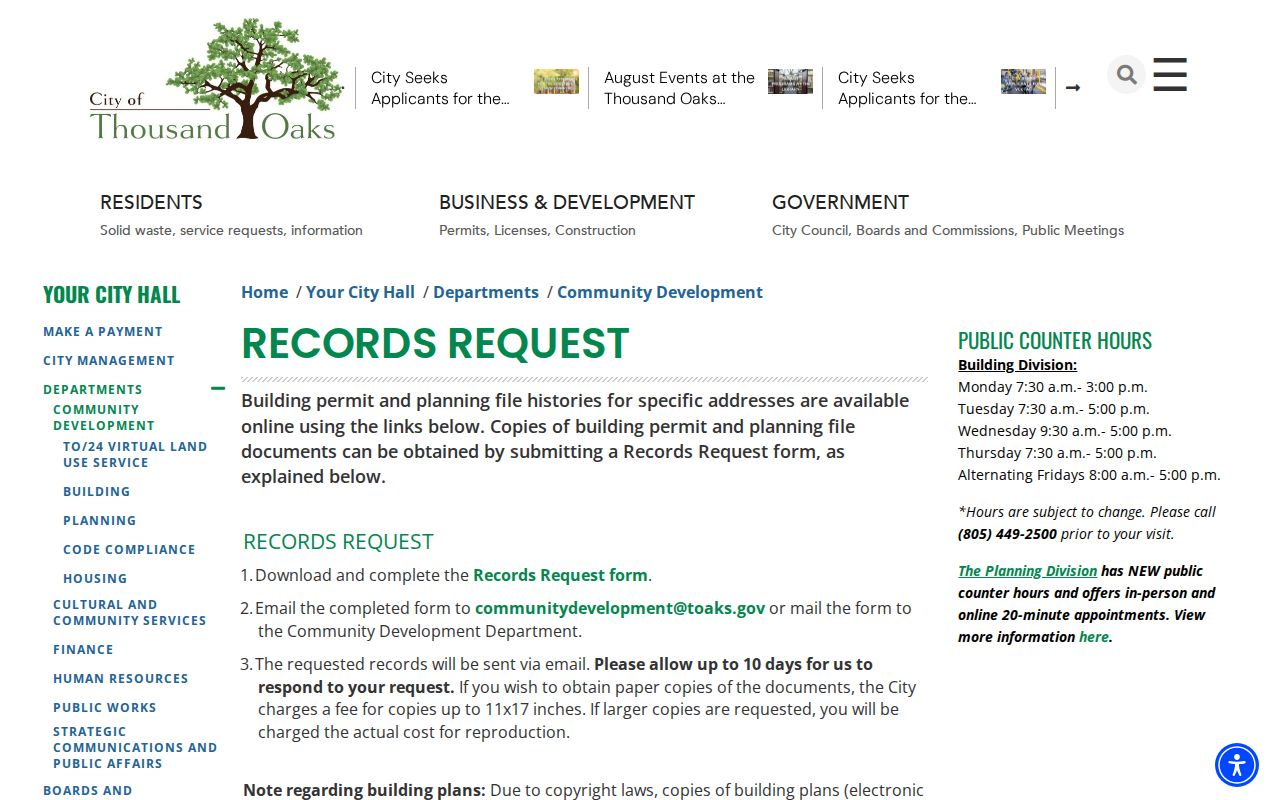
Missing items can be pursued with the city.
| Field label | Type | Required | Options or format notes |
|---|---|---|---|
| Search method | Dropdown | Yes | Select All for an address history. |
| Street Number | Text | Address method | Numeric address component. |
| Street Name | Text | Address method | Enter separately from the number. |
| Exact Phrase | Checkbox | Recommended | City instructions direct users to check it. |
| Filter Results | Facets | No | All, Permit, Plan, or Inspection. |
| Export | Button | No | Saves the result set as CSV. |
The TO/24 parcel and permit portal adds a project trail to the APN and deed chain.
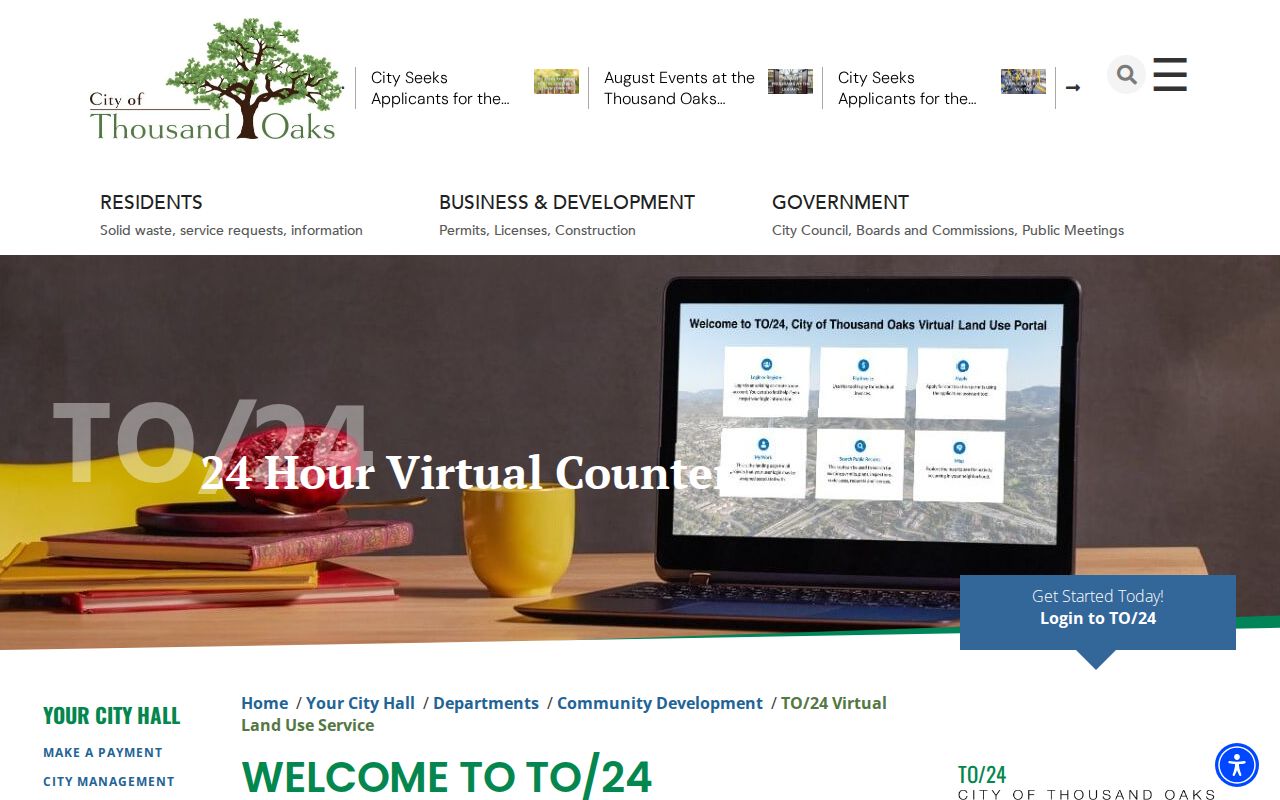
CSV export preserves the address history. A permit contact remains a project connection, not proof of a household.
Note: TO/24 public searching is separate from applicant functions, and plan copies follow the city's consent process.
Thousand Oaks Street Permit and Oak Files
Address evidence can come from city code and land-use records. Code Compliance covers zoning, property maintenance, protected oak and landmark trees, inoperable private-property vehicles, and unsafe conditions. A complaint includes the subject-property address. Anonymous complaints are not investigated, and reporter identity is confidential subject to law.
Records use the city request channel. Plans may be viewed, but copies require written consent from the property owner and architect or engineer. The city says the professional has 30 days to respond. These limits matter when a project file offers land history but the plan cannot simply be copied.
The third image links to Thousand Oaks Code Compliance, the source for address-linked complaint and enforcement channels.
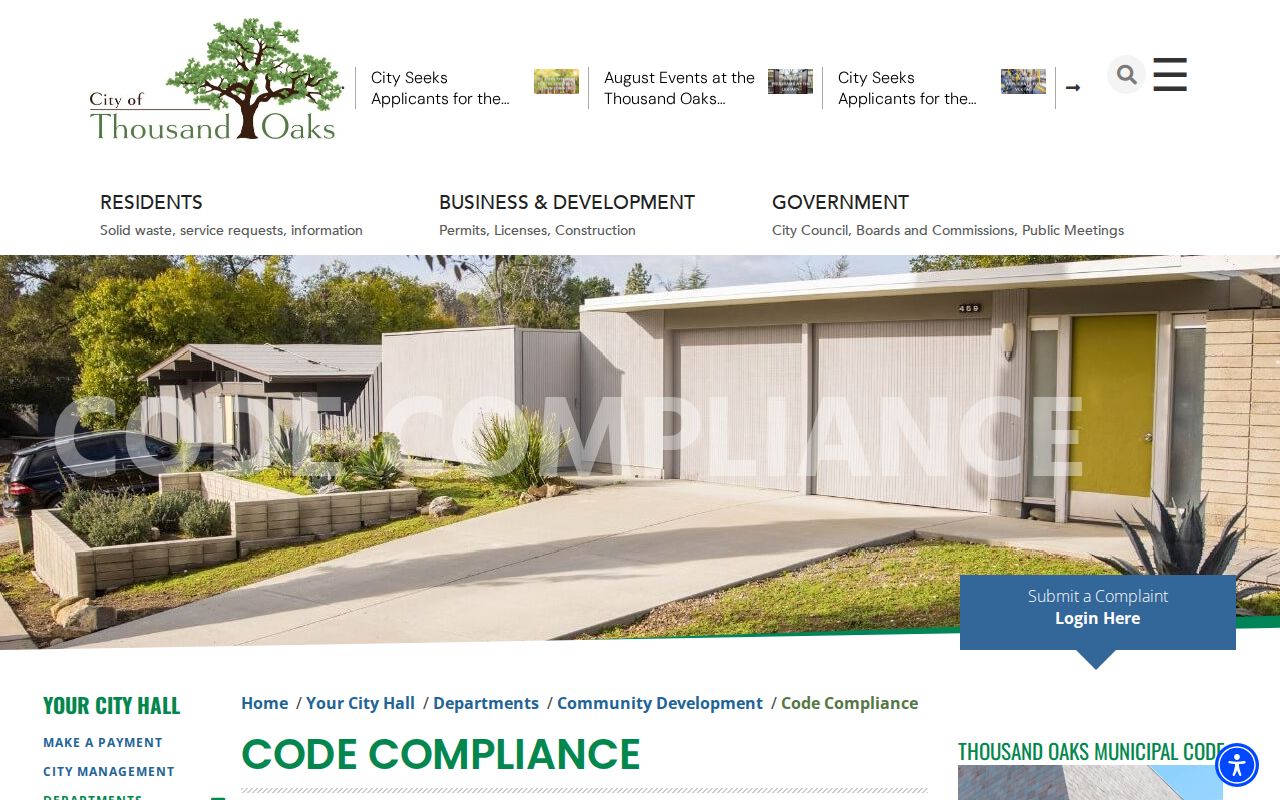
Oak, code, permit, and inspection entries place civic events at a parcel. Read them beside the deed and map.
Thousand Oaks Street Deed Chain
The Ventura Recorder's index is a grantor and grantee catalog, not an address directory. Start with the current Assessor owner as grantee, obtain the acquisition deed, record the seller, date, document number, and legal description, then search the seller as grantee. APN, book or page, and legal description guard against an incomplete street label.
Ventura County holdings begin in 1873, but the official online-index cutoff was not located. An empty result does not prove an older deed is absent. The Ventura County Clerk-Recorder East County Office is at Civic Arts Plaza, 2100 E. Thousand Oaks Boulevard, Suite A, Thousand Oaks 91362, (805) 449-2157. It offers real-estate recording and public search Monday through Thursday 8 to 4 and alternate Fridays 8 to 3:30; appointments are requested.
The main counter is at 800 S. Victoria Avenue in Ventura. Recorder phone service is (805) 654-3665, with counter hours Monday through Friday, 8 to 4:45. Ask about index books, images, or copies ordered by document number or book and page.
Note: A recorded deed can establish a title event and legal continuity, but it does not by itself establish a current household or residence.
Thousand Oaks Street Criss-Cross, 1962 to 1985
The Library of Congress street-address guide identifies the verified Oxnard, Camarillo, and Thousand Oaks run from 1962 to 1985. These reverse directories are arranged by street and address. Open a year, find the address, record the listed subscriber and nearby entries, then compare editions. The run helps when a deed shows land continuity but a person trail needs a date.
Do not attribute this exact run to the Thousand Oaks Library. Older entries can use a locality or property description instead of a numbered street. The 1958 regional telephone volume adds a Thousand Oaks section on images 97 to 100, including the HUdson exchange and rural descriptions such as Lake Sherwood. Because the city incorporated in 1964, older listings may need county or Conejo Valley terms. A listing is a lead, not proof of title or a complete household.
The historical volumes and reading methods are on the Thousand Oaks city directory page. Pair an entry with a deed, the 1950 census, a permit, or a citation.
Postal Labels Mislead Thousand Oaks Streets
Thousand Oaks address research crosses city limits, Ventura County parcels, postal names, ZIPs, and service districts. The city GIS base-data service separates Zipcode, City Limits, Addressing Grid, Council Districts, and Adjacent Cities layers. A postal city is not a legal boundary.
Use the USPS ZIP Lookup for the complete address. The core pattern is 91320 for Newbury Park and western Thousand Oaks, 91360 for north and central Thousand Oaks and Wildwood, 91361 for the southern and eastern edge with Westlake and Lake Sherwood associations, and 91362 for eastern and northeastern Thousand Oaks and Westlake-area addresses. USPS routing associates 91360 and 91362 with Thousand Oaks and 91361 with Westlake Village.
Codes 91319, 91358, 91359, and 91363 need address-level verification because current special, legacy, or edge classification was not conclusively established. Repeat Thousand Oaks, Newbury Park, Westlake Village, Conejo Valley, and subdivision terms in free-text searches. The city's water-provider information distinguishes mailing-city names from service geography.
Note: A postal city, precinct label, and service area can describe the same place without defining the same boundary.
What the Thousand Oaks Street Directory Misses
An address-keyed record set is not a complete resident list. The Assessor identifies an owner or controlling interest on the lien date; County View maps land; a permit identifies a project event; and a criss-cross volume identifies a subscriber for one edition. None supplies every person connected to a parcel.
DMV address data is restricted under the federal Driver's Privacy Protection Act. Utility customer and library circulation records are not public directories. The city HOA layer lists organizational fields such as association, tract, type, management company, address, phone, fax, and email, not members.
Stop at the documented boundary when an official source does not publish a household name. Use lawful family-history, estate, civic, reconnecting, or personal-safety purposes and verify results with the custodian.
Privacy Limits on Thousand Oaks Address Records
California voter information has a narrower path than a parcel search. The Secretary of State's voter-status tool is self-lookup, not public name-and-street browsing. Broader files require applicant identity, contact details, a qualifying election, scholarly, journalistic, political, or governmental purpose, and certification. The rules cite Elections Code sections 2166.9, 2188, 2194, and 18109, Government Code section 7924.000, and related regulations.
Safe at Home can provide a qualifying participant with a substitute mailing address, so a protected person may not appear in ordinary address work. DMV records remain constrained by the DPPA and California vehicle law. Utility and delivery information is not a public street directory, and lawful file requests still exclude protected records and withheld identifiers.
Privacy boundary. Elections Code restrictions control voter-file access and use. Safe at Home can shield a qualifying address, while DMV and utility limits keep private location data out of ordinary searches. Never use address records to stalk, harass, intimidate, or harm another person.
Cite the source, preserve the date and parcel key, and state what remains private.