
Thousand Oaks Previous Resident Sources
Previous residents leave different traces in different record systems. The Ventura County Recorder supplies the ownership chain, while the Assessor and GIS establish the parcel that an old deed may describe in a different way. Telephone and criss-cross directories add listed subscribers or occupants. Census schedules show a household at one moment, and the library’s index and image collections supply names, notices, photographs, and local context. TO/24 adds a project timeline for the physical property. The table keeps those roles distinct so a deed is not mistaken for a household list, and a directory entry is not treated as proof of title.
| Source | Years It Covers | Where Held | What It Shows |
|---|---|---|---|
| Ventura County Recorder holdings | 1873-present | Ventura Recorder and East County counter | Grantors, grantees, instruments, legal descriptions |
| Assessor and County GIS | Current roll and parcel context | Ventura County portals and map viewer | Owner, situs, mailing, APN, tract, map, adjacency |
| Regional telephone directory | 1958 | Library of Congress digital pages 97-100 | Listed subscriber, address or locality, HUdson number |
| Oxnard-Camarillo-Thousand Oaks criss-cross run | 1962-1985 | Library of Congress | Listed occupant or subscriber by street and address |
| Federal census | Through 1950 | NARA and partner access | Household at the census date and pre-incorporation geography |
| Thousand Oaks Local News Index | 1985-April 20, 2016 | Thousand Oaks Library | Obituary, birth, marriage, civic, and photo citations |
| TO/24 permits and plans | Exact start not verified | City of Thousand Oaks | Permit, plan, inspection, payment, and status history |
Thousand Oaks Deed Records Backward
The Ventura County Recorder’s index is a grantor and grantee catalog, not an address directory. A grantor transfers an interest. A grantee receives it. To find previous residents through ownership, begin with the current Assessor record, locate the acquisition instrument, then turn the seller into the next grantee search. The legal description and APN help keep the chain tied to land when names, mailing addresses, or street labels shift.
- Search the Ventura County Assessor by known address or APN. Record the owner, exact situs, mailing address, APN, and legal description.
- Use the Ventura County Recorder index or counter to locate the current owner as grantee. Note the document number, record date, instrument type, seller, and legal description.
- Search the seller as grantee in an earlier transaction. Compare the legal description and APN before accepting the match.
- Repeat the grantee-to-grantor move for each earlier transfer. The exact online cutoff is unknown, so do not claim that a web result is the full record.
- When the online trail ends, ask the Recorder staff about 1873-forward index books and images at the East County or Ventura public-search counter.
- Grantor and grantee
- The grantor gives or transfers an interest; the grantee receives that interest in the recorded instrument.
- Chain of title
- The linked sequence of recorded transfers that connects a later owner to earlier owners of the same land.
- Legal description
- Land-identifying wording such as a lot, block, tract, or other recorded description that can remain useful when a street address changes.
The Recorder access page is the source for the image below; use the underlying instrument when a transfer matters.
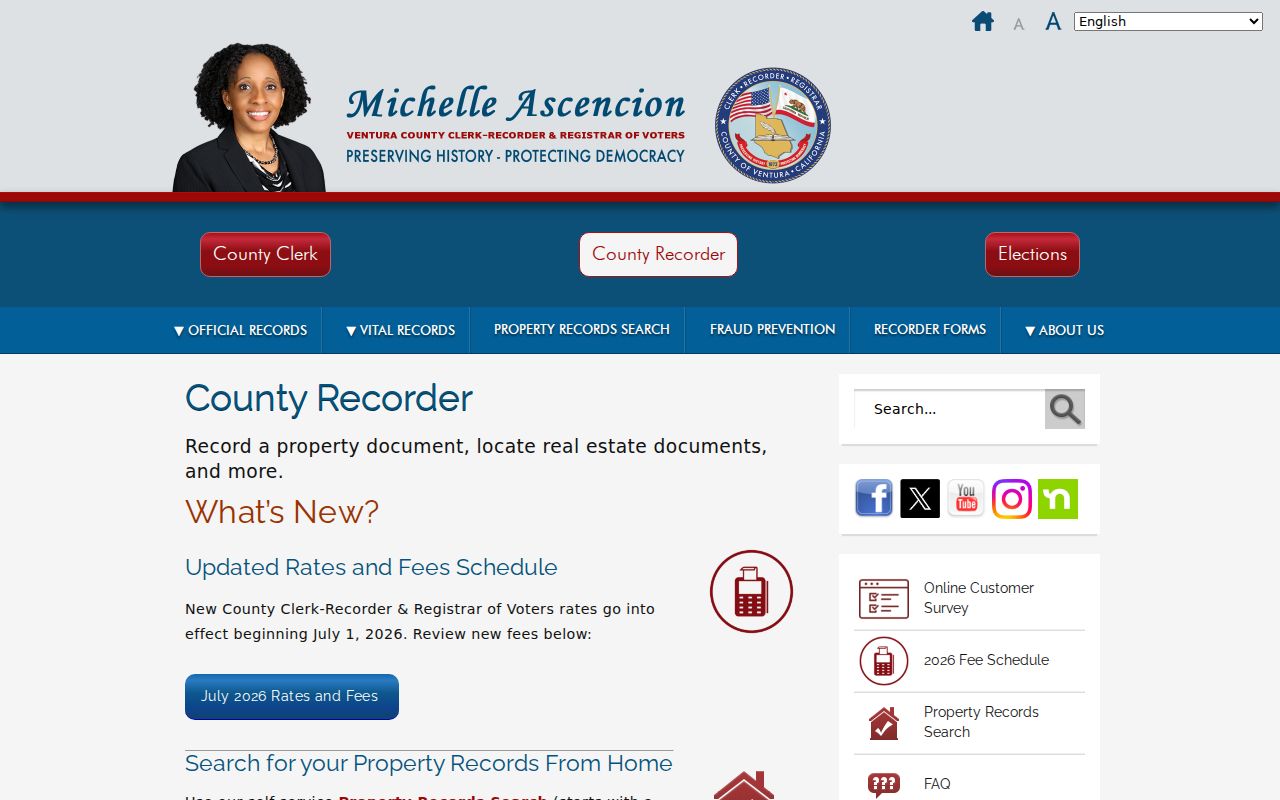
The custodian’s copy or image is the stronger source when a legal description must be read in full.
APNs Keep Thousand Oaks Records Connected
Three address keys should travel together: situs, mailing address, and APN or legal description. Situs is the physical property location in the Assessor record. Mailing address receives tax or assessment notices and may point somewhere else. APN identifies the parcel, using the Ventura format XXX-X-XXX-XXX. A Homeowner’s Exemption can show an owner’s principal-residence claim, but it is not a roster of everyone at the property.
County View can resolve an address through Assessor situs autocomplete, highlight a parcel, and expose APN, tract, map, acreage, book, page, block, and parcel fields. Its public parcel schema does not expose owner names or mailing addresses, so bridge from GIS to the Assessor or Recorder. Use the geometry and legal identifiers to test continuity, not to infer a household.
Thousand Oaks Permit Records Date a House
TO/24 provides a second timeline for a Thousand Oaks address. Choose Search or Search Public Records, set the search method to All, enter Street Number and Street Name, check Exact Phrase, and run the search. Results can be narrowed to Permit, Plan, or Inspection. A blue plan number opens details, Map accepts an address, and Export saves a result set as CSV. Public searching is separate from applicant functions.
| TO/24 signal | What it can add to a house history | Limit |
|---|---|---|
| Permit | Application, approval, status, and project address | Applicant is not necessarily a resident |
| Plan | Plan identifier and linked project details | Copy requests may require consent |
| Inspection | Inspection and status events | It dates a project, not a full household |
| Export | CSV inventory of returned records | Retain the search terms and date |
The city says records can be requested by email or mail when copies are needed, with a response allowed up to 10 days. Copyrighted building plans have an owner and architect or engineer consent process. Use the city’s address-history instructions for the exact path.
Thousand Oaks Pre-Incorporation Records
Thousand Oaks incorporated on September 29, 1964. A household living in the Conejo Valley before that date will not be found in a City of Thousand Oaks municipal file simply because the later address lies inside today’s boundary. County deeds, census schedules, regional telephone pages, newspapers, and library collections carry the earlier trail. Search older records under Ventura County, Conejo Valley, Newbury Park, or a locality description when the source uses place names rather than a city field.
The 1958 regional telephone directory is a useful pre-incorporation snapshot. Its Thousand Oaks pages are images 97-100 in a Santa Paula regional book. Entries may show a personal or business name, street number, street or rural locality, and a HUdson exchange number. A rural description such as Lake Sherwood may stand in for a numbered street. A phone listing can place a subscriber in an area, but it does not prove title or the complete household.
The City of Thousand Oaks local-history collection page gives the official chronology and points to the library’s broader memory record. The image below is linked to that source.
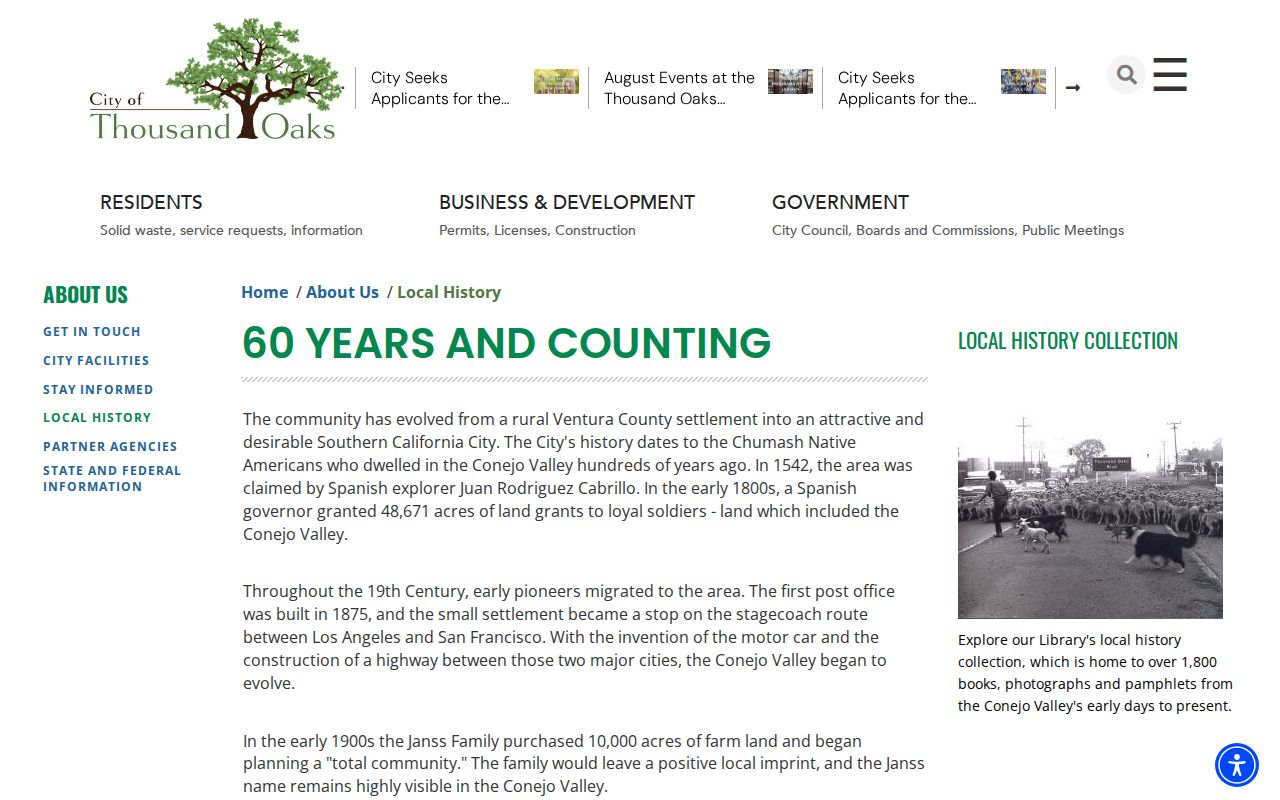
Use local-history images to generate a name, place, or event lead, then confirm it with a deed, directory, census, permit, or newspaper citation.
Thousand Oaks Criss-Cross Directory Years
The Library of Congress holds the verified Oxnard-Camarillo-Thousand Oaks street-address run for 1962-1985. These are reverse or criss-cross directories arranged around streets and addresses, not a confirmed Thousand Oaks Library shelf. They can show a listed subscriber or occupant and nearby entries for a chosen edition. Pair them with census work instead of reading a single line as a full household record.
- Open the correct year in the Library of Congress street-address directory guide and locate the street and address.
- Write down the listed name, nearby entries, telephone information when shown, and the edition year. Compare the same address across the next edition.
- Search the 1950 census by name, enumeration district, and location. The 72-year release rule makes 1950 the latest currently available federal population schedule for this workflow.
- Match the household clue to the deed chain, TO/24 project dates, Local News Index, probate, or an obituary. Keep the city-incorporation date in view when older records use county geography.
The historical collection details belong with the Thousand Oaks city directory collections, while the backward address trail belongs with the deed and parcel records. Keeping those record roles separate makes previous-resident research easier to audit.
Thousand Oaks Local News Records
The Thousand Oaks Library Local News Index covers 1985 through April 20, 2016. It is a citation index, not a full article archive, but its fields are unusually useful for family and address history: byline, headline, complete publication date, paper, section, page, column, subjects, article type, keywords, and birth or death dates when supplied. Article types include obituary, birth announcement, marriage announcement, photograph, map, and statistics.
Search personal-name subjects as last name first, with the given name optional. Punctuation and case are ignored, and an asterisk wildcard can bridge spelling variants. Retrieve the underlying News Chronicle text on microfilm or a library database when a citation needs context. The guide says reference staff can pull reels and that prints cost $0.15 per page. Use the index to locate a notice, then compare its dates and relationships with probate petitions, deeds, and census entries.
Thousand Oaks East County Record Access
When a web index is blocked, incomplete, or silent, the Ventura County Clerk-Recorder’s East County Office provides a local fallback. It is inside the Thousand Oaks Civic Arts Plaza at 2100 E. Thousand Oaks Boulevard, Suite A. The listed phone is (805) 449-2157. Hours are Monday through Thursday, 8 a.m. to 4 p.m., and alternate Fridays, 8 a.m. to 3:30 p.m.; appointments are requested. The counter offers real-estate recording and public-search services along with vital, marriage, and fictitious-business-name services.
Ask staff about the 1873-forward holdings, index books, and images, and state the exact address, APN, document type, or date span. The online cutoff was not verified, so a counter search may be the correct next step rather than evidence that no deed exists. For city-held records, Laserfiche and a focused City public-records request provide another route.
Request with a record in mind. A California Public Records Act request should identify an existing department record by address, date range, and record type. It does not require an office to create a new list of previous residents.
Thousand Oaks Ownership Records and Occupancy
The Assessor identifies the person owning, claiming, possessing, or controlling taxable property on the lien date. That role is not the same as every person who used the address. A mailing address may belong to a trust, a post office box, a management office, or another property. The Homeowner’s Exemption records a principal-residence claim when applicable, but it is not conclusive proof of who lives there.
The same care applies to older sources. A telephone subscriber may be one member of a household. A criss-cross entry may omit others. A permit applicant, contractor, or project contact may have no residence connection. Previous residents research is strongest when two or more independent records agree on the land, person, and time period.
Thousand Oaks Previous Residents Across Time
Past households become clearer when the ownership trail and the people trail are kept side by side. Use deeds and APNs for land continuity. Use directories and census schedules for listed households. Use TO/24 for changes to the physical site, and the Local News Index, probate, and obituaries for names, relationships, and life events. A present address search can begin the work, but previous residents often emerge only after the record era has been identified.
When the goal shifts from one house to the full current road, the Thousand Oaks street directory is the better next source. It follows the address chain across a named street, while the backward trail here stays focused on one parcel and its former households.
Lawful use. Previous-resident research is appropriate for house history, family history, estate work, and personal curiosity. Do not use records to stalk, track, intimidate, or harass a living person.