
Thousand Oaks Resident Records by Type
A Thousand Oaks resident lookup is really a chain of small searches. It is not one master list. The trick is matching each known fact to its custodian. Assessor rolls tie an owner to a parcel. A deed confirms a transfer. A court index lists a party, and a newspaper index flags a published event.
| Record | What It Confirms | Where | Access |
|---|---|---|---|
| Assessor roll | Owner of record, situs, mailing destination, APN | Ventura County Assessor | Public site or counter; owner-name capability not verified |
| Recorded deed | Grantor, grantee, recording date, document number, legal description | Ventura Recorder | Counter or appointment; online cutoff not verified |
| Court index | Party name, case number and type, filing events | Ventura Superior Court | Free unofficial index; sensitive access limits |
| Vital record | Event identity, date, place, and related persons where shown | County Clerk-Recorder or CDPH | County or state application; copy eligibility applies |
| Voter self-status | The requesting voter’s own registration status | California voter status | Self-lookup; full file restricted |
| Business or FBN | Entity affiliation, agent, filing, or fictitious business name | California SOS or Ventura Clerk | Search access varies by filing |
| Professional license | License identity, number, status, and board-specific fields | California DCA | Free public search |
| Permit history | Project, applicant, contractor, address, and status clues | Thousand Oaks TO/24 | Public search; copies follow city rules |
| Local newspaper index | Obituary, birth, marriage, civic, or photo citation | Thousand Oaks Library | Free index; article access by microfilm or database |
Roles matter here. Pick the row that matches the fact you hold, then hunt for a second record agreeing on a date, APN, middle name, relationship, or event.
Two-Record Thousand Oaks Resident Match
Careful name searching starts with variants. Write down the full name, the middle initial, any former surname, hyphen or space spellings, and a known address or event. Matching first and last names alone is never enough to merge two entries.
- Anchor the search to the known fact: assessor, GIS, and TO/24 for an address; SOS, FBN, or license sources for an organization; vital, court, or news records for an event.
- Run the second source with the same spelling variants and compare at least two independent attributes.
- Keep owner, mailing recipient, occupant, applicant, litigant, licensee, and voter as separate labels.
- Open the underlying deed, image, docket entry, or article when an index cannot resolve a same-name result.
- Ask the custodian to correct an official error. A directory search cannot change the government record.
- Docket
- The court’s running record of a case, including the filings and events the index makes visible.
- Index versus image
- An index is a searchable pointer; an image is the scanned or photographed underlying record.
- Certified copy
- A custodian-attested copy for formal proof; personal research may not require one.
Stronger anchors include an APN, a legal description, or a middle name. A public role can also help. So can a timeline that lines up across records. A broad place name proves little. Never guess at a protected address or a date of birth.
To trace every address along a road, use the Thousand Oaks street search. For historical name trails, the city directory collections are the right stop.
Thousand Oaks Court Lookup Cutoffs
Ventura Superior Court splits its online case inquiry into separate modes. Civil, Probate, and Small Claims form one. Family Law stands apart. Criminal or Traffic rounds out the list. Anything found online is an unofficial index, not the official court record. Date windows also limit results. That explains many apparently empty searches during a Thousand Oaks resident lookup. Check the court inquiry page to see the separate choices before picking a mode.
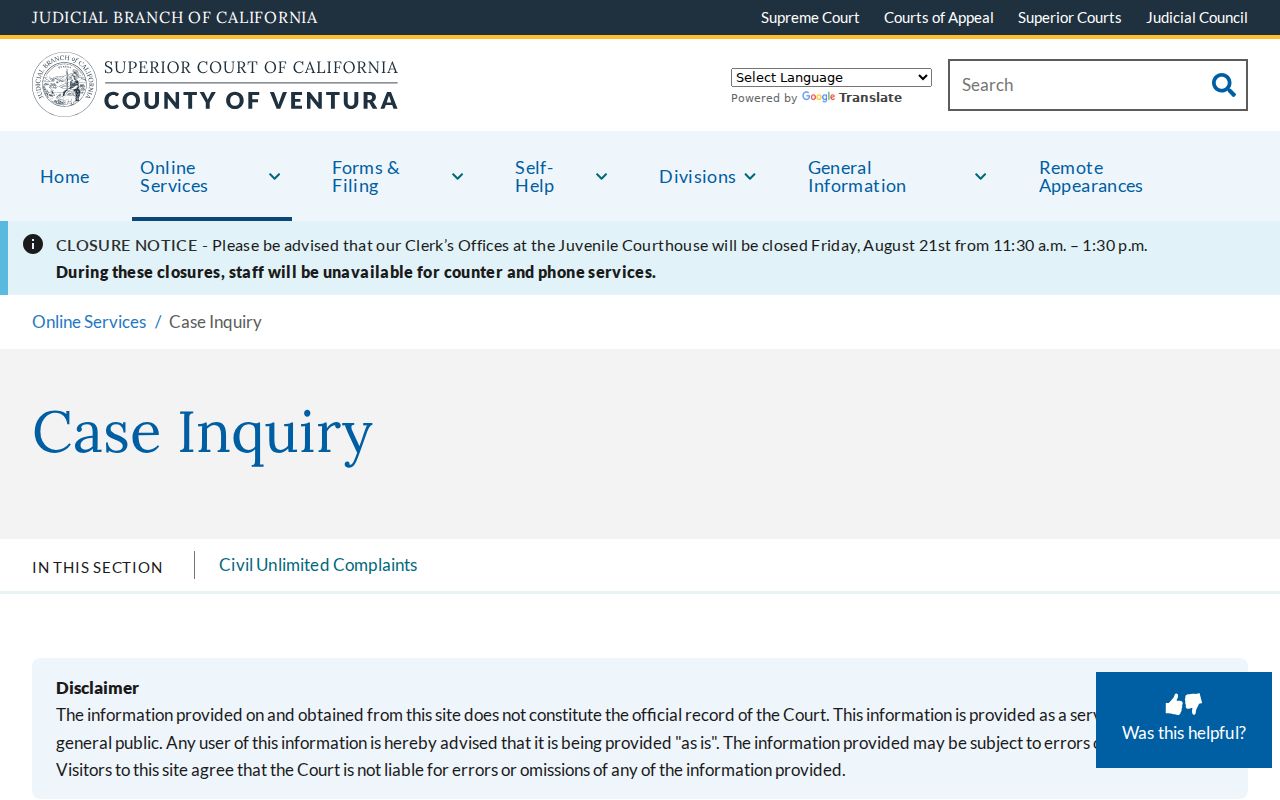
The mode sets the search path; the courthouse holds the official file for inspection.
| Civil, probate, small claims | Unlimited-jurisdiction searches reach 1873 to present; many older cases are on microfilm, while limited or municipal coverage is generally about seven years. |
|---|---|
| Family Law | The database begins September 1, 1991, with later cases and thousands of active older cases; earlier coverage is incomplete. |
| Criminal and traffic | Municipal coverage begins January 1, 1989; the combined superior and felony system begins in 1995, with older coverage partial. |
| Search inputs verified | Criminal uses First Name and Last Name or Case Number. Traffic uses Citation Number. DOB and driver-license searches were removed in 2021. |
A cautious inventory lists only what the index shows: party name, case number, case type, and filing events. Nothing more. Adding a disposition, document detail, or image the portal never exposed would overstate the record.
- Party name and spelling used
- Case number and database mode
- Visible filing events
- Clerk access note for the official file
Free public terminals sit in Hall of Justice Room 218 and Juvenile Courthouse Room 122. A researcher surrenders identification. The researcher may not remove or photograph a file. Offsite retrieval sometimes means a wait. Staff will not search by phone. A written or in-person search runs $15 for up to 15 names. Form VN266 supports mail requests to the Records Department in Ventura. Copies cost $0.50 per page. Certification adds $40 per document. A certified final dissolution judgment is $15, and exemplification runs $50 plus page costs.
Thousand Oaks Vital Record Copies
Ventura County keeps birth, death, and marriage records from 1873 forward. The Clerk-Recorder and East County Office hold them. Statewide births at the California Department of Public Health reach back to July 1905. Other record types fall under separate rules. A confidential marriage record stays with the issuing county. It is ordinarily open only to the spouses.
Health and Safety Code section 103526 draws the line between an authorized certified copy and an informational copy marked not valid for identity. An authorized copy proves identity for an eligible requester. Authorized applicants typically show an eligible relationship, submit a sworn statement, and mail a notarization. The California vital-record guidance lists each requirement.
| Birth | State fee $31; eligibility and sworn-statement rules apply. |
|---|---|
| Death | State fee $26; informational copies are available under the form rules. |
| Public marriage | State fee $19; authorized statutory requesters sign the required statement. |
| Confidential marriage | State fee $19; the issuing county controls access. |
| Dissolution certificate | State fee $18; a court judgment is the proof of divorce itself. |
| Fetal death or stillbirth | State fees are $23 and $28 respectively. |
CDPH certified copies typically take four to six weeks, while amendments run seven to nine weeks. The county office is sometimes faster. Applicants use state forms and approved mail payment. A vital application confirms an event and eligibility, not a current address.
Thousand Oaks Voter Lookup Limits
California's voter-status form is a self-check. The Secretary of State tool is not a name-and-street directory. Ventura verification is also available from the Registrar of Voters at (805) 654-2664. No unverified input list belongs in any residents directory entry.
The full voter file is restricted under California Elections Code sections 2194 and 2195. Related rules also apply. Qualified election, scholarly, journalistic, political, or governmental users may request it. They must provide identity, contact, purpose, and certification details. Personal, private, and commercial use is forbidden. Protected voters, preregistered minors, and confidential participants are withheld. Any optional history file records voting method only. It never records ballot choice.
A voter result can help the requester verify personal status. It cannot lawfully turn a casual name search into a block roster. It also cannot prove that another person lives at a given address.
Thousand Oaks Business Record Trails
Business filings can separate two people with the same name. They prove affiliation, though, not where someone lives. The California Secretary of State's bizfile system takes a business name or file number. Basic search runs on keyword or contains matching. It defaults to active entities and demands three characters. Results stop at 500. Advanced filters add starts-with matching, entity group or type, status, filing dates, and public-company disclosures.
A bizfile hit can list the entity name and number. It also shows formation or registration date, status, jurisdiction, street or mailing address, agent, Statement of Information due date, and filing PDFs. The SOS gathers no ownership data. Ventura's FBN index works separately as a name lookup. A city Business Tax Certificate links activity to a person or entity. The DCA portal queries by board, license type or number, business, first or last name, registry number, and advanced criteria. Treat the DCA search as a role and status check rather than a home-address directory.
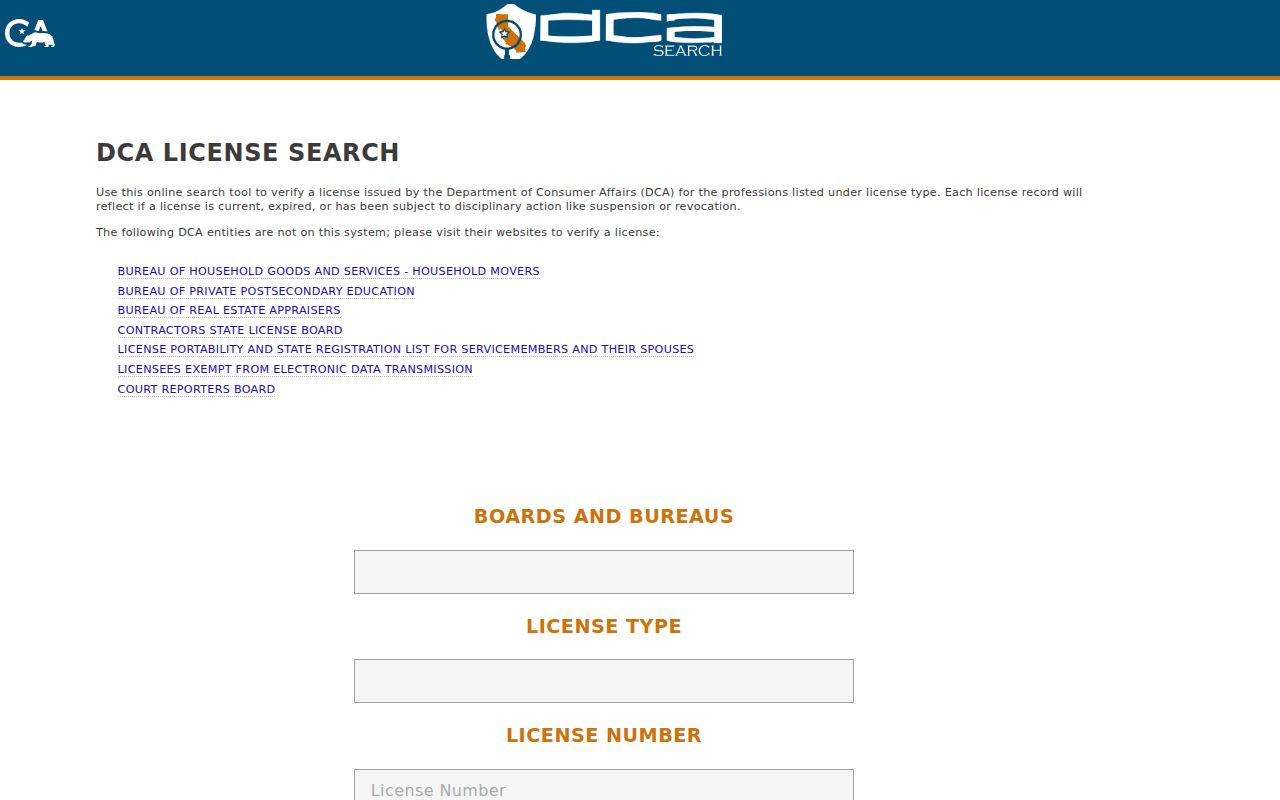
Before a business tie becomes identity evidence, weigh the license, FBN, entity, or permit date against a second local record.
Thousand Oaks Heir Record Trails
The California Controller's unclaimed-property search takes a name or property number. An optional address and city can narrow the results. A less-specific-match option is available, and a CAPTCHA guards the search. Heirs, trustees, and personal representatives can claim online, by phone, or by mail. Any match is just a claim lead. Notarization applies to claims of $1,000 or more and to some securities.
Probate notices, estate deeds, and the Thousand Oaks Local News Index offer different family clues. Enter names last name first. Dates follow year, month, day. An asterisk wildcard bridges spelling variants because case and punctuation are ignored. Article types span obituaries, birth announcements, marriage announcements, and photographs.
Yearbooks, newspaper indexes, and school or alumni channels help locate former classmates. Birth-parent and adoption matters in California demand the confidential official process. Never rely on inference from a restricted certificate.
Thousand Oaks Court Access Rules
California Rule of Court 2.503 permits electronic indexes, registers, and calendars. Remote documents in sensitive matters face limits. The California Courts access explanation draws a line between courthouse inspection and remote viewing. Adoption, juvenile, sealed, and confidential records require legal authority. What a visitor can see at the courthouse can exceed what the public portal displays. The official access page makes that remote-versus-courthouse boundary visible.
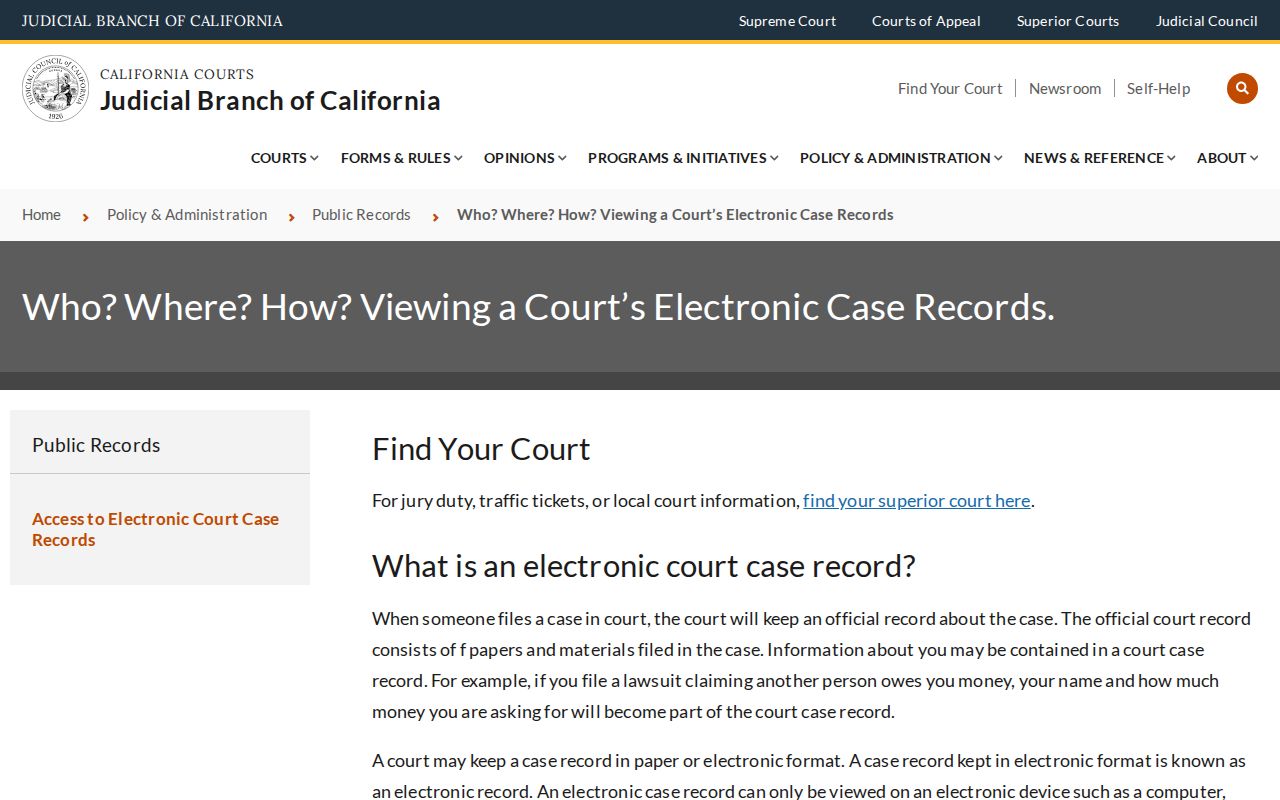
Treat a result as a pointer. It should lead to the right clerk or case file. A missing remote document is not a missing case, and a disposition or field the portal never exposed should not be claimed.
Thousand Oaks Records Request Fallback
A blocked index does not end a Thousand Oaks resident lookup. California's Public Records Act offers a focused fallback. Government Code division 10, part 5, chapter 1, starting at section 7920.000, lets anyone request an identifiable existing record. No purpose statement is required. The agency has 10 calendar days to decide whether records are disclosable. An unusual-circumstances notice can stretch that by no more than 14 days.
Name the department, record type, address or existing person identifier, and a narrow date span. CPRA does not compel a new resident list or an answer to a question. Copies carry direct duplication cost or a statutory fee. On-site inspection and personal photographs may be free, subject to safeguards.
- Identify the custodian, such as the City Clerk, Community Development, County Recorder, or another named department.
- Describe an existing record by type, address, date span, and known identifier.
- Ask for the statutory response and any lawful partial disclosure if exemptions apply.
- Verify any copy through the issuing office before relying on it for estate or identity work.
Thousand Oaks Resident Lookup Limits
Not everyone shows up in an open lookup. Safe at Home gives qualifying California residents and household members facing stalking, domestic violence, or abuse a substitute mailing address and confidential voter registration. Enrollment happens in person through an enrolling agency. Certification lasts four years, and state and local agencies must accept the substitute address.
Lawful personal use. A Thousand Oaks resident lookup is for personal, lawful research such as family history, estate work, civic records, or reconnecting. Do not use a record to stalk, harass, intimidate, or harm another person.
State law also shields DMV address data, library circulation records, certain voter information, and sensitive court papers. A protected address, sealed case, household member, or borrower may be absent by design. When something looks wrong, return to the custodian and preserve the source date.